The original Christmas story
This article is contributed by Ray Konig, the author of 301 Prophecies Fulfilled by Jesus, Jesus the Messiah, Jesus the Prophet, Jesus the Miracle Worker, and 100 Fulfilled Bible Prophecies.
By Ray Konig
Published: November 25, 2025
This article borrows details from the books Jesus the Messiah and Jesus the Miracle Worker, by Ray Konig, which are available on amazon.com. A similar article by Ray Konig can be found at Mary's journey to Bethlehem.
Some 2,000 years ago, a pregnant woman from Nazareth traveled to the town of Bethlehem, near Jerusalem. It was a journey that would take several days, and she was about to give birth.
Her name was Mary and she traveled with Joseph, to whom she was engaged to be married. She became pregnant through a miracle by God (Luke 1:26-38).
Joseph, as a descendant of King David, was making the journey to his ancestral home of Bethlehem to take part in a census within the Roman Empire (Luke 2:1-21), which included the land of Israel.
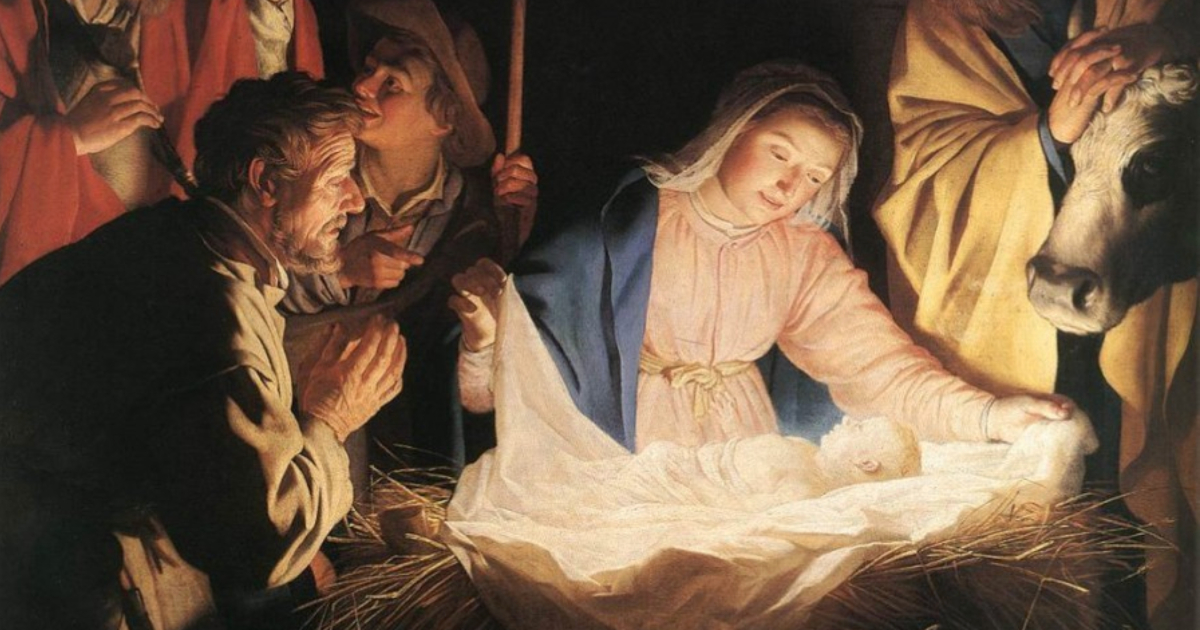
Painting: Cropped image of "The Adoration of the Shepherds" (1622), by Gerard "Gerrit" van Honthorst (1592-1656).
When they arrived in Bethlehem, they found no guest rooms where they could stay, so they took shelter where they could. It is traditionally believed that they ended up in a stable, one that was part of a house, or part of a cave. Caves were common among the limestone hills of Bethlehem. They often were used as shelters for livestock.
It was then that Mary gave birth to a baby who would become the most influential person in history. The baby was placed in a manger (Luke 2:7), an open, wooden box that was used for feeding animals.
The birth of Jesus is recorded in the first two chapters of the Gospels of Matthew and Luke in the New Testament of the Bible. Those verses describe the birth as being miraculous, that Jesus was conceived by the Holy Spirit and born of a virgin mother.
Isaiah foretold the virgin birth
The birth of Jesus wasn’t just a miracle, it was also the fulfillment of prophecy. About 700 years before the time of Jesus, the prophet Isaiah foretold that the Messiah would be born to a young woman who is a virgin, who is old enough to be married, and who is destined to be married soon:
13 He said, “Listen now, house of David. Is it not enough for you to try the patience of men, that you will try the patience of my God also? 14 Therefore the Lord himself will give you a sign. Behold, the virgin will conceive, and bear a son, and shall call his name Immanuel.” (Isaiah 7:13-14, WEB)
In this prophecy, the Hebrew word alma, as found in the underlying Hebrew text for Isaiah 7:14, is commonly translated into English as virgin.
This Hebrew word is defined only once in the Old Testament, in Genesis 24:16-43. In those verses, we are introduced to a young woman named Rebekah, who later becomes the mother of the people of Israel. She becomes the first woman to whom all Israelites can trace back their ancestry.
In Genesis 24:16, we are told that she is a virgin. Later, in Genesis 24:43, she is addressed with the Hebrew word alma, within the underlying Hebrew text. In between verses 16 and 43, it is revealed that Rebekah soon would be married to Isaac, the son of Abraham.
In other words, the Hebrew word alma is defined in Genesis 24:16-43 and is used in Genesis 24:43 to refer to a young woman who is a virgin, who is old enough to be married, and who is destined to be married soon.
And that is how the word is being used in Isaiah’s prophecy, in Isaiah 7:13-14, that the Messiah -- the promised son who would be born to the house of David -- would be born to a young woman who is a virgin, who is old enough to be married, and who is destined to be married soon.
And that describes Mary of Nazareth. At the time when she is making the journey to Bethlehem, she is a young woman who is a virgin, who is old enough to be married, and who is destined to be married soon.
We can know, definitively, that Isaiah 7:13-14 is talking about the Messiah because previous prophets in the Old Testament already had established that prophecies about a promised son, who would be born to the House of David, and who would be extraordinary in a divine way, are prophecies about the Messiah.
For example, about 3,000 years ago, the prophet Nathan gave a prophecy, in 2 Samuel 7:12-16, that foretold that the Messiah would be a promised son, born to the House of David, and he would be divinely extraordinary. In that prophecy, we learn that the Messiah would have divine ability to inherit and preside over an eternal kingdom (the Kingdom of God).
With Isaiah 7:13-14, which was received about 2,700 years ago, Isaiah is revisiting and reaffirming key points of Nathan’s prophecy -- that the Messiah would be a son born to the House of David -- and he is adding details about the extraordinary nature of this promised son. He would have a conception and birth worthy of prophecy and worthy of being prefaced as a sign from God. He would be born to an alma, which is defined in Genesis 24:16-43 as being a young woman who is a virgin, who is old enough to be married, and who is destined to be married soon. And, he would be called Immanuel, which means God with us.
These prediced details, namely the virgin birth and being called God with us, are related. It is the miraculous nature of this birth that positions the Messiah to be both human and divine, to actually, literally, and plainly be God with us, just as Isaiah actually, literally, and plainly foretold. Because Jesus was conceived by the Holy Spirit and born of a woman, he is fully human and fully divine. He is God with us.
As explained throughout the New Testament, Jesus, by way of his miraculous birth, is God incarnate. He is able to be perfect, sinless, humanly mortal and divinely eternal, to suffer and die for our sins, to be resurrected, to offer salvation, to preside over Judgment Day, and to reign eternally over the Kingdom of God, also known as the Kingdom of Heaven.
The journey to Bethlehem
We don’t have details as to the exact route that Joseph and Mary took from Nazareth to Bethlehem, but there is much that can be gleaned from history and cartography.
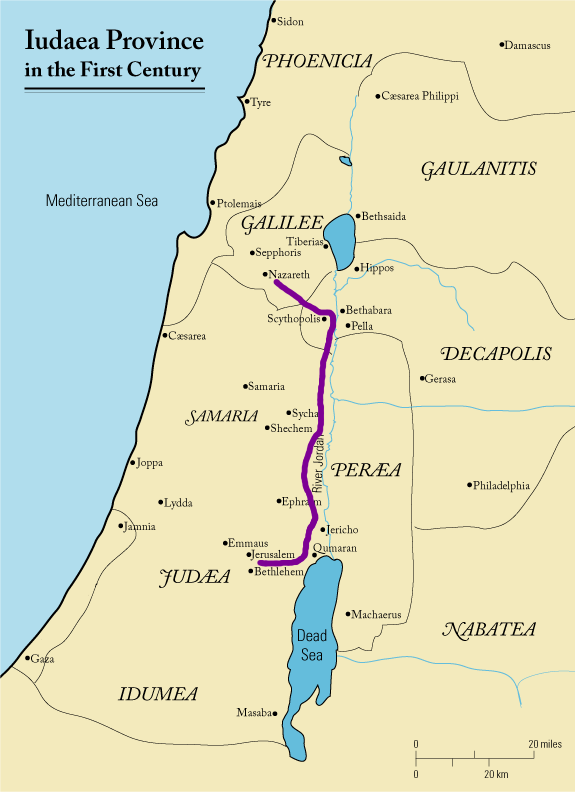
Map of first-century Israel, which consisted largely of the regions of Judah (Judaea), Samaria, Galilee and Perea (Peraea).
Nazareth is a small town in the region of Galilee, which covers much of northern Israel. Bethlehem is a small town in the region of Judah, which comprises much of southern Israel. For a bird in flight, the two towns would be about 70 miles (115 kilometers) apart. But for a person traveling on foot, the path could exceed 100 miles (160 kilometers), through varying terrain, and the journey could last anywhere from 4 to 10 days.
A common route that people would take to get from Galilee to Jerusalem, which is near Bethlehem, was to head east to the Jordan River, and then travel south along the river’s path until arriving near the Dead Sea. At that point, the travelers would head west into the area of Jerusalem and Bethlehem. That route is confirmed by Josephus, a first-century Jewish historian, as being common for Jews in Galilee traveling to and from Jerusalem, for various yearly festivals, in his work The Wars of the Jews, 2.232-233. With this route, travelers would have convenient access to water during their journey.
Joseph, as a tradesman, a carpenter, might have owned a donkey, which would have been able to assist in carrying supplies for the journey, and for allowing Mary breaks from walking the entire distance.
The route along the Jordan River also allowed the Jews to avoid traveling through the region of Samaria, which is in central Israel, between Galilee and Jerusalem. Samaria was populated largely by Samaritans, with whom the Jews shared an antagonistic relationship. The Samaritans largely were descendants of foreigners who were brought into central and northern Israel about 2,700 years ago, when the Assyrians had conquered that part of Israel.
Aside from animosities with Samaritans, travelers also would need to be vigilant about gangs of bandits who would seek to rob the travelers. To minimize these threats, it is possible that Joseph and Mary traveled as part of a large group of people, to find safety in numbers, as they journeyed south for the Roman census.
Micah foretold Bethlehem as the birthplace
Bethlehem plays a critically important role in the Old Testament of the Bible. When the very first king of Israel, Saul, had turned away from God about 3,000 years ago, God sent a prophet named Samuel into Bethlehem to anoint a new king -- a king who would be faithful to God.
That king was David, who at that time, about 3,000 years ago, was a young shepherd, perhaps a teenager. David later became ancient Israel’s greatest king. And, for the many mistakes that David made, as documented in the Old Testament, he ultimately proved to be a faithful servant of God, and God, through the prophet Nathan, in 2 Samuel 7:12-16, announced that the Messiah would be a descendant of David.
With this background in mind, there is a poetic symmetry to having the Messiah be born in Bethlehem. Just as surely as ancient Israel’s greatest king was born in the humble town of Bethlehem, so too would the promised King of Kings, the Messiah. And that is what was being predicted and promised by a prophet named Micah gave about 2,700 years ago:
1 Now you shall gather yourself in troops, daughter of troops. He has laid siege against us. They will strike the judge of Israel with a rod on the cheek. 2 But you, Bethlehem Ephrathah, being small among the clans of Judah, out of you one will come out to me that is to be ruler in Israel; whose goings out are from of old, from ancient times. (Micah 5:1-2, WEB)
In Micah’s prophecy, the Messiah is addressed as the promised ruler, as in the promised king from the House of David. And Jerusalem is addressed as the daughter of troops and as the location in which a predicted siege was about to take place.
This prophecy is saying that the Messiah would not come from Jerusalem, where the House of David resided and controlled the throne for the Kingdom of Judah (southern Israel), but from Bethlehem, the humble village in which David himself had been born.
This prophecy eliminates all other towns, villages and settlements in the land of Israel, as well as anywhere else in the world, as places in which the Messiah would be born. He would be born in the town of Bethlehem, in the region of Judah, in southern Israel, just as David had been.
Soon after Joseph and Mary had completed their journey from Nazareth to Bethlehem about 2,000 years ago, Mary gave birth to Jesus. And Jesus became the only person in history to have ever been widely acknowledged as the Messiah.
And he became the last son born to the House of David to ever be revered as king. Jesus, today, is revered as the promised king, the King of Kings, by more than 2.3 billion Christians throughout the world.
© Ray Konig
Ray Konig is the author of 301 Prophecies Fulfilled by Jesus, Jesus the Messiah, Jesus the Prophet, Jesus the Miracle Worker, and 100 Fulfilled Bible Prophecies.
Related articles
• Isaiah predicted the miraculous virgin birth of Jesus
• The Messiah would be born in Bethlehem
• Bethlehem - Messiah's birthplace: A detailed look at Micah 5:2 and the objections that skeptics have
Next: Jesus accurately predicted the future
Go to: List of all articles